


New investigation by Zembla: “How your ‘green electricity’ contributes to deforestation.”
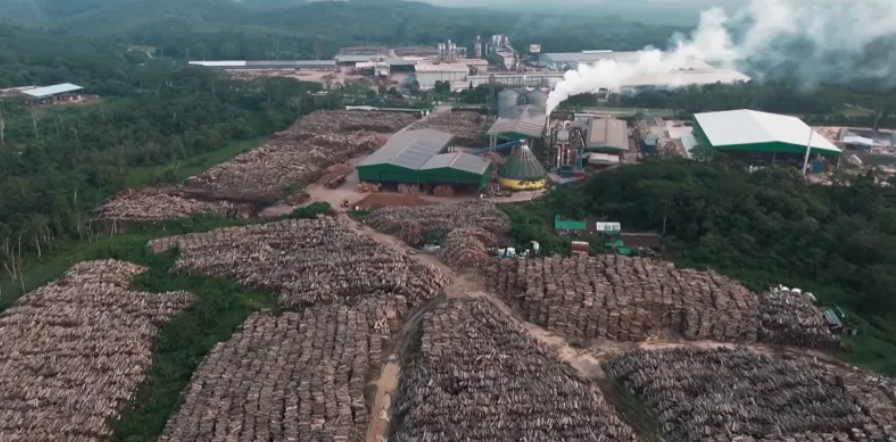
PHOTO Credit: Rainbow Pellet’s factory, Zembla.
Energy giant RWE burns an estimated 1.5 million tonnes of biomass every year in its power plants. The company also receives €2.5 billion in subsidies for replacing coal with biomass.
In a recent documentary, Zembla, a Dutch TV programme, investigates where RWE’s supply of wood pellets comes from.
RWE’s Eemshaven power plant in Groningen is the largest coal-fired power plant in the Netherlands. Since 2019, RWE has burned biomass along with coal to generate electricity at the Eemshaven plant.
RWE’s Amer power plant in Geertruidenberg, runs entirely on biomass.
The limited supply of wood residues in the Netherlands means that RWE imports as much as 200,000 tonnes of biomass from Malaysia.
Here is Zembla’s documentary (in Dutch) “How your ‘green electricity’ contributes to deforestation”: https://www.youtube.com/watch?v=RKV9TVQ3dvo
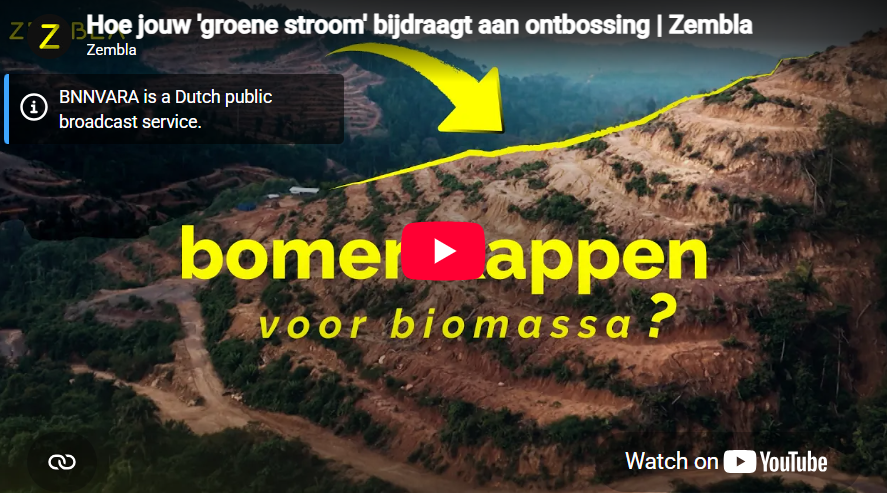
Zembla travels to Malaysia and visits the Rainbow Pellet factory in the state of Pahang. Rainbow Pellet is the largest Malaysian exporter of wood pellets to Europe. Zembla tried to get in touch with management of the factory several weeks before arriving there. Without success. The company is apparently not keen on having Dutch journalists around.
On paper, the wood pellets are sustainably produced. But behind the labels and certificates Zembla found a murky reality.
In June 2025, Biofuelwatch and Comité Schone Lucht (Clean Air Committee) filed a complaint to the Dutch Emissions Agency about RWE’s wood pellet sourcing.
Zembla interviews Fenna Swart of Comité Schone Lucht. We see her filing a complaint with the police that argues that wood from primary forests ends up in RWE’s power plants despite the wood being classified as residual waste wood. The complaint alleges fraud, document forgery, and greenwashing.
Margo Verbaarschold works for the national police unit investigating large-scale environmental crime. “Given the stack of documents,” she tells Zembla, “and the preliminary investigation, I’d certainly say something isn’t right.”
The “Category 5” loophole
Swart argues that the certification label that allows RWE to receive billions in subsidies is meaningless. “The label essentially created a loophole to bypass the world’s strictest sustainability criteria,” she tells Zembla.
Swart explains that there are strict requirements to be met in order to qualify for subsidies for using biomass. But the loophole is that wood is classified as “Category 5” waste, meaning that much less stringent rules apply. “Category 5 is very interesting because it implies that the biomass originates from sawdust, residual material, or waste,” Swart explains. “And in that case, you don’t have to look at the origin.” The wood is classified as waste.
Eric Wakker, senior policy advisor at Earthqualizer, has been researching deforestation in Southeast Asia for decades. “Waste wood comes from the sawmill,” Wakker says. “It doesn’t come from the forest. That is simply nonsense of course. That wood comes from the forest. And if that forest isn’t managed sustainably, then it isn’t a sustainable wood pellet.”
In addition to the police investigation into RWE, the Dutch Food and Consumer Product Safety Authority (NVWA) has imposed a provisional fine, because RWE cannot prove that its biomass does not consist of illegal timber.
RWE claims to be using scraps and that these are the best sustainability standards in the world. RWE claims the pellets are manufactured from pruning waste, crooked or rotten trees, and sawdust. On its website, RWE states that, the wood comes from “sustainable forestry.”
However, RWE does not disclose the specific forests that the wood comes from.
RWE claims that transparency is crucial for getting society on board with the energy transition. At the same time, RWE declines to give an interview about the origin of its biomass.
Zembla found that the Rainbow Pellet factory is using whole hardwood logs, including from clearcutting in biodiverse rainforests.
Is biomass CO₂-neutral?
Zembla speaks to Martijn Katan an emeritus professor at the Vrije Universiteit Amsterdam. For several years, Katan has argued against burning wood for energy, which he describes as “a disaster for the climate”.
“If you use wood as fuel in power plants,” Katan says, “the entire process releases far more CO₂ into the atmosphere than coal does.”
Zembla asks Olog van der Gaag, chair of the Nederlandse Vereniging Duurzame Energie (NVDE — the Dutch Renewable Energy Association) why biomass is still classified as renewable energy when burning wood releases more CO₂ than burning coal.
Van der Gaag argues that when trees die, the CO₂ stored in the trees is returned to the atmosphere. This is CO₂-neutral “provided you do it in a sustainable way,” van der Gaag says with a focus on residual streams associated with sustainable forest management. “The reason is that nature always grows back. And while nature is growing, it absorbs CO₂ again.”
But as Katan points out, “what counts is the next 10, 20, 30, 40, 50 years, when we face the threat of a climate catastrophe.” During that period we need to release as little as possible CO₂ to the atmosphere. “And that’s where the problem lies if you burn it now instead of leaving it standing,” Katan says.
“It sounds really nice,” Lim says. “What you’re doing is consuming something that would have just been left to rot.” But the problem is that the biomass industry is creating a new market and increasing the demand for wood. “And where there’s demand, where you can make money, then people want to fulfil that supply and make some money on their end.”
A visit to Rainbow Pellet’s factory, Malaysia
Zembla takes drone footage of Rainbow Pellet’s factory site. It is full of large stacks of tree trunks. Some of the wood comes from rubber plantations that are too old to produce enough rubber. And some of the wood is clearcut from rainforests. After weeks of back-and-forth, RWE finally confirms to Zembla that whole trees are being used to manufacture its wood pellets.
Ton van der Ham, Zembla’s journalist, speaks to a truck driver parked near the entrance to the factory. The driver says his truck is loaded with timber from Kuala Betis in the state of Kelantan.
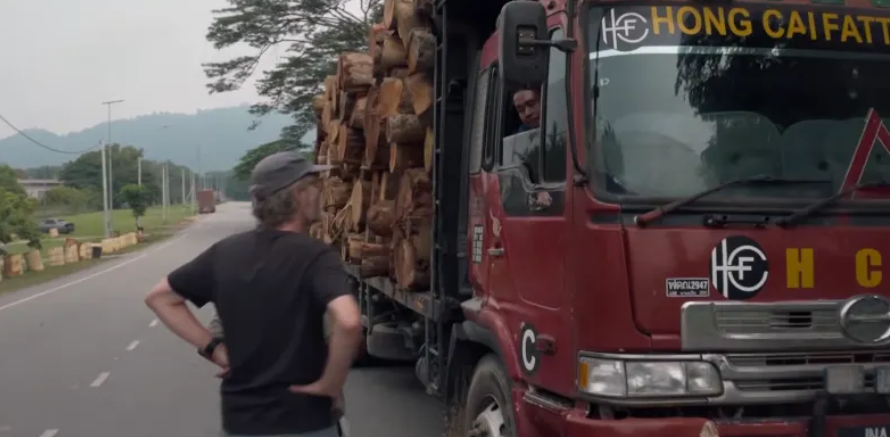
PHOTO Credit: Zembla.
Zembla speaks to another driver who has just finished unloading at Rainbow Pellet. He says he delivered scraps from a sawmill nearby. The sawmill gets its trees from Gua Musang, also in Kelantan.
Zembla travels to Kelantan in the north-east of Malaysia. Mustafa Along, an Indigenous leader of the local Orang Asli community, helps them. They come across an area of forest that is being clearcut.
“When trees are felled in Malaysia now, the same species are not replanted,” Along explains. “Instead, the areas are converted into monoculture plantations.”
Everything is removed from the forest. Logs, small trees, branches.
Zembla speaks to environmental scientist Teckwyn Lim of the University of Nottingham, Malaysia. Lim explains that the development of the biomass industry in recent years is increasing the demand for wood and is changing the way forestry operators work.
“So, normally when you fell a big tree, and you want it for the timber, you won’t take the branches. You leave the branches behind. In fact the whole top section and the bottom section, the roots and the branches are discarded and left in the forest. And that has some value in the sense that for nutrient cycling and the dead timber is important for wildlife as well. So it’s good that they leave parts of the trees behind and only take out the middle section, the straight section of the timber. But the risk now is that if there’s a market for it, if they know they can sell it for biomass, then they will be taking everything out.”
At the end of its investigation, Zembla manages to get in touch with a a forester in Kelantan who supplies wood for Rainbow Pellet. At first, with the camera rolling, he doesn’t want to confirm his relationship with Rainbow Pellet. However, when Zembla shows him a table of Dutch import figures, he admits that he supplies residues and wood to Rainbow Pallet.
He says he clearcut one of his concessions six years ago and replanted it with monoculture plantations. He started supplying Rainbow Pellet five years ago.
Zembla looks at satellite imagery together with Eric Wakker. “Not so long ago, this was all still natural forest,” Wakker says. “The, suddenly, a year later, in December 2021, we see that a large part of the concession has already been clearcut.”
Wakker adds that, “RWE is burning tropical rainforest in Dutch power plants. That’s what it boils down to. According to Dutch standards, the wood is supposed to come from a sawmill. But the reality is simply different; it comes from the tropical rainforest.”
In a statement, RWE writes that, “All raw materials procured by RWE continue to meet the applicable requirements regarding legality, sustainability, and greenhouse gas reduction. This is verified by an independent, accredited certification body.”
For questions about biomass from recently deforested areas, RWE refers Zembla to Rainbow Pellet.
In a statement, Rainbow Pellet writes that, “Our operations comply with applicable certification standards and legal regulations. Compliance is periodically verified by independent parties.”
Rainbow Pellet did not respond to Zembla’s questions about deforestation by one of its suppliers.